2014年12月23日 星期二

The Future Blueprint for Public Transportation

Public Transportation

Bus application

Acrosser’s in-vehicle computer is capable of multitasking during the drive, enabling the realization of numerous advanced commercial applications. The advance in public transportation technology greatly benefits both passengers and carriers.

For example, the installed counter collects and sends passenger information to the data center, enabling carriers to determine suitable advertisements for passengers and increase potential revenue. In the safety aspect, the GPS can provide instant vehicle location, and remind drivers to stay cautious in certain traffic congestion areas. Surveillance centers may also monitor drivers and passengers instantly via the IP camera, ensuring a safer transportation environment. In addition, the connected Wi-Fi module receives signals coming from the bus stop to provide an accurate arrival information display to waiting passengers.

2014年12月15日 星期一

Team Up AR-B8172 with Your CNC Machine


ACROSSER Technology, a world-leading industrial computer manufacturer, introduces its ISA board,AR-B8172, which targets the value-based CNC machining and automation industry. As industrial automation techniques advance, the original manufacturing facilities are being phased out and be replaced with the new ones. But for factory owners with constrained budgets, finding a reliable ISA board supplier for their vintage CNC machines is a challenge. Acrosser’s fanless AR-B8172 ISA board offers accurate respond to your computer numeric control machine, and can overcome the heat dissipation difficulties encountered in factories. Customers can also purchase chassis, integrating theISA board to the machine all at once.
ISA boards are commonly used in industrial automation. They connect the CPU, motion controller cards, and other I/O interfaces. CNC machining and electrical discharge machining are perfect examples of ISA board applications.
Stability and cost-efficiency are two benefits of ISA boards. But Acrosser’s AR-B8172 offers even more features for your CNC machine, including:
1. Fanless design
2. Support for PC/104 interfaces
3. Support for multi-input devices
4. Durability, stability, and ease of integration
5. SRAM for data storage

And last but not least, Acrosser’s field application engineering team provides advanced services using their in-depth technical service and knowledge. It is Acrosser’s quality products and attentive service that makes your manufacturing goods unstoppable and profitable!


2014年12月8日 星期一

Flying Inventory Assistants Are a Good Use for Drones


It’s starting to seem like “throw a drone at it” is the solution that everyone wants to somehow solve every single problem everywhere, ever. And in most cases, it’s not going to work anytime soon, for reasons that we continue to belabor. This is not to say that drones aren’t valuable tools that can solve many network hardware problems: the key is to find a problem that needs a drone, as opposed to having a drone and then desperately looking for some problem for it to solve. The Fraunhofer Institute for Material Flow and Logistics, in Dortmund, Germany, may have found one of these problems: taking inventory in a warehouse. To do this efficiently, you need a mobile antenna that can navigate in three dimensions, and autonomous flying robots certainly fit the bill. Inventory is awful. I say this from experience, having made the mistake of accepting a department store inventory job for a few weeks in high school. Taking inventory in a store or warehouse involves wandering around and recording the location of every single item, using an RFID antenna or optical scanner. Did I mention that doing this by hand is awful? Because it’s awful.

One option to make inventory less painful is to deploy an infrastructure of networking appliance with built-in RFID readers, such that the shelf can tell what’s being stored on it. (Another, even better option is doing what Kiva Systems, now owned by Amazon, does: its inventory system keeps track of both the networking appliance and contents of every bin in the warehouse, so when you need to retrieve or restock something, you just send robots do get those bins for you.) This can work very well, but it’s expensive and hard to scale. Fraunhofer’s idea is to forget about the fancy shelves and instead replace what is usually a small army of inventorying humans with a small fleet of autonomous, inventorying drones that use RFID antennas or cameras to identify the location of items.

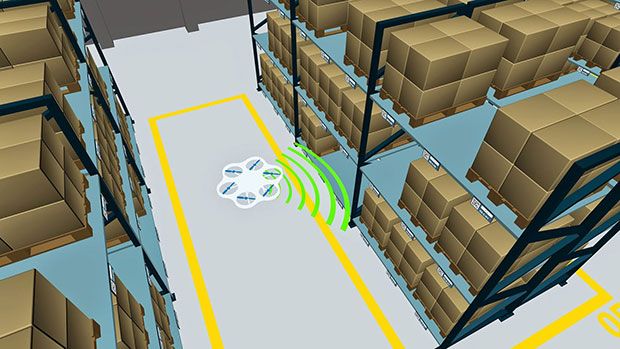
Drones are a good idea for inventory management for several reasons. First, they’ll be operating in a semi-structured (or entirely structured) environment. If they’re in a retail store, the environment is probably considered semi-structured, since humans can be kept out of the area while the robots do their work and the environment is generally static and well-defined. A warehouse might be a structured environment, since it can be completely restricted and mapped in advance with very little risk of change.

Also, an network hardware inventory drone can have an immediate and significant benefit on the inventory task in a way that would be hard to do otherwise. The reason a drone is so potentially useful is that warehouses maximize space utilization by stacking inventory as high as possible. A human would need a ladder just to read any identifying information, but for a drone, the height above the ground doesn’t matter all that much, especially if it’s equipped with a long-range RFID reader.

Fraunhofer’s InventAIRy Project (nice, right?) is developing “autonomous flying robots that are capable of independently navigating and conducting inventory.” The drones won’t be relying on an external navigations systems: it’ll all be onboard, using ultrasound sensors, 3D cameras, and laser scanners to perform continuous  simultaneous localization and mapping (SLAM). By mid-2015, Fraunhofer’s prototype system should be operating with partial autonomy, navigation around shelving and avoiding other obstacles. The next step will be to add RFID antennas, database integration, and (most challenging) an effective path-planning algorithm that allows the robot to reliably and efficiently catalog the objects in an arbitrary space.

We’re more optimistic about the networking appliance useful potential of InventAIRy than we are about most of the drone-related ideas that we come across, but as with anything related to robots, there’s a huge step between good idea and good execution. We’ll keep you updated.

refer to:
http://spectrum.ieee.org/automaton/robotics/aerial-robots/flying-inventory-assistants-are-a-good-use-for-drones

2014年12月2日 星期二

The Internet of Things Gets a New OS


British processor powerhouse ARM Holdings, said last week that it intends to launch a new, low-power operating networking appliance system that will manage web-connected devices and appliances using chips based on the company’s 32-bit Cortex-M microcontrollers.

The operating system, called mbed OS, is meant to resolve productivity problems that arise from fragmentation—where different devices in the so-called “Internet of things” (IoT) market run on a hodgepodge of different protocols. ARM is looking to consolidate those devices under a single software layer that's simple, secure, and free for all manufacturers to use.

“Instead of having large teams spending years designing a product,” rackmount vice president of research and development Kriztian Flautner told the BBC, “we'd like to turn that into months, so that you can take the [hardware] components, assemble the right ones, connect the device and focus on the problem you are solving and not the means to getting there."

In the last few years, rackmount has made a push networking appliance to develop more technologies designed for firewall IoT products. In a Pew survey this past spring, 83 percent of respondents thought the future of IoT would help improve their lives. Gartner, a tech research firm, recently predicted that by 2020 there will be 26 billion Internet-connected devices, an almost 30-fold increase from 2009.

However, this is the first operating system ARM has ever developed.

The mbed OS supports several standards of connectivity, including Wi-Fi, Bluethooth Smart, Thread, and a sub-6-gigahertz version of 6LoWPAN. It also supports many cellular standards, including 3G and LTE. At the same time, ARM is launching mbed server software, which the company says will allow users to gather and analyze data collected from IoT devices.

The OS was designed with power efficiency and battery life in mind. ARM claims it will only take up 256 kilobytes of memory, compared to the several gigabytes worth of storage needed for a smartphone OS. The company hopes developers will use mbed to create devices with battery lives measured in years.

Parts of the OS will be open source, though ARM says it wants to retain control of other parts to ensure mbed remains unfragmented. A recent EETimes study reports that in-house and custom designed systems for IoT devices are on the decline. Open source code already runs in 36 percent of embedded operating systems and is projected to keep rising, with Android and FreeRTOS leading networking appliance the pack. ARM seems to be trying to balance the advantages of development flexibility with proprietary control, but it remains to be seen how well that rackmount plays out.

Chris Rommel from the VDC Research group also told the BBC that while firewall believed most companies would welcome this news, it was unlikely the mbed OS would find its way into all IoT devices. "There will likely never be any one operating system—or even two or three—that can satisfy the broad ranges of needs of all the various devices that compose the Internet of things. They are just too different."

Already there are some big networking appliance appliance makers who are sure to resist the mbed OS. GE employs the software Predix in almost all its IoT products, and Samsung is heavily invested into using firewall Tizen for its family of IoT devices. Nest Labs's products run on a proprietary software based on Linux, though that's likely to shift to Android soon due to company's acquisition by Google.

However, that hasn't squelched enthusiasm from other companies yet. ARM will release the OS to hardware manufacturers and other developers before the end of the year, and says 25 companies have already signed up, including Ericsson, Freescale, IBM, NXP, and Zebra. The first networking appliance devices to use mbed OS are expected to arrive in 2015.

refer to: 
http://spectrum.ieee.org/tech-talk/computing/embedded-systems/the-internet-of-things-gets-a-new-os

2014年11月25日 星期二

Build Your UTM with Acrosser’s Network Appliance

UTM

ACROSSER Technology, a world-leading network communication designer and manufacturer, has released a video introducing its latest network appliance product line. The x86-based Network Platform enables network security appliance providers to develop its UTM devices in a unified structure.

In the video, Acrosser elaborates the 6 basic functions that an UTM device embodies: anti-virus, anti-spam, fire wall, intrusion detection, VPN and web filtering. These applications provide immediate protection for business owners from external Web attacks, keeping your network safe and clear. Connected with integrated networking software, Acrosser’s network appliance can perform advanced network management functions such as remote visibility control and bandwidth management.

Currently ACROSSER offers micro box and 1U rackmount for system integrators.  To learn more about our networking products, please visit our website for detailed information.

2014年11月17日 星期一

Create a “Wheel of Excuses” With BASIC and the New Raspberry Pi single board computer

Many years ago in the offices here at IEEE Spectrum, we had a “Wheel of Excuses” pinned to the outside wall of a embedded computer cubicle. So I turned to the US $35 Raspberry Pi single board computer, which had the final release of its first generation in July—the Model B+. Among other changes, the Model B+ has two more USB ports than the Model B along with an expanded general-purpose input/output (GPIO) connector, and it relies more heavily on HDMI for video output.

photo of Model B+ RaspberryPi
The Model B+ Raspberry Pi has an upgraded version of the I/O hardware in the Model B. RasPiO breakout board Using a RasPiO breakout board, I connected a button to the 40-pin GPIO header. screenshot of presented excuse Button presses generate excuses, which appear on a monitor attached via an HDMI cable. Old-school BBC Micro users will note my use of text mode 7, which supports Teletext commands for things like displaying double-height characters.

The Pi was first released in 2012 as a “spiritual successor” to the BBC Microcomputer System, which was created by Acorn single board computer in 1981 for Britain’s national Computer Literacy Project. The naming scheme for Pi models echoes that of the BBC Micro series, and like the original BBC Micro, the Pi has rapidly spread beyond the classroom.

The links to the BBC Micro are more than just circumstantial. The Pi is built around an ARM chip (a Broadcom BCM2835), and while ARM currently dominates the world of smartphones and tablets, the architecture was originally developed to provide a high-performance embedded computer coprocessor for BBC Micros, and it later powered the Archimedes line of PCs. The embedded sbc Archimedes came with RISC OS, a graphical user interface–based operating system that has since been ported to the Pi.

I first used Acorn’s dialect of BASIC way back in the day on a BBC Micro. One of the nice things about it was that it let you mix BASIC commands with assembly code for the BBC Micro’s 6502 processor. I was pleased to discover that RISC OS has retained a great deal of compatibility with the systems it grew out of, right back to that original dialect.

RISC OS’s version of embedded sbc BASIC—version VI—is, of course, greatly expanded compared with its 8-bit ancestor: As I said when I first tried it out, “it’s like meeting someone you palled around with in high school, and now they own a business and have two kids.” But it still includes an in-line assembler for combining machine code subroutines—now ARM code, of course—with BASIC. The single board computer integration allows for streamlined passing of variables back and forth between a BASIC program and machine code—for example, a set of BASIC integer variables, A% through H%, are automatically copied into the first eight embedded computer registers of the ARM chip when a subroutine is called.

This integration let me quickly write the spinning wheel animation and display code in BASIC, reaching back across the years to cobble together commands to draw colored segments of a circle and store the text of excuses using “data” and “read” commands. (When I started programming, BASIC embedded computer code would have been too slow for the wheel’s animation, but 30 years of Moore’s Law has solved that problem.) I needed to dip into assembly only in order to read the state of a button connected to the GPIO hardware. The button triggers the animation and has the program select and display an excuse.

I wired the button to the Pi’s GPIO port using a $10 RasPiO Breakout Pro, which provides basic protection against miswiring. (Unlike the more robust Arduino, which can handle enough current to drive a servo, the Pi’s GPIO can be damaged if connected to circuits that expose it to more than a few milliamperes or exceed 3.3 volts.) The Breakout Pro is designed for the GPIO on earlier Pi models, but the B+’s expanded port keeps the same pin configuration for the first 26 pins, so I was able to use the Breakout Pro and simply ignore the B+’s extra pins.

Reading the GPIO hardware was a good chance to get acquainted with the guts of a system using a reduced-instruction-set-computing architecture (so many registers!)—the last time I programmed on the metal was for the 6502. The Pi’s GPIO pins are mapped into the system’s memory as a series of 3-bit segments stored within 32-bit status words, so my machine code subroutine has to do some bit bashing to set a GPIO pin as an input. Then my subroutine reads the relevant GPIO status word and passes it back to BASIC. (For my code, I combined some snippets from Bruce Smith’s book Raspberry Pi Assembly Language RISC OS Beginners and a Raspberry Pi online forum.) My BASIC program then simply uses a loop that calls the subroutine and looks for any changes in the status word, indicating a button press.

With the embedded sbc software written, all that was left to do was build a case (from a few dollars’ worth of basswood) and hook the video output up to an old monitor. And voila! A new era of digitally driven excuses.

This article originally appeared in print as “Back to BASIC.”

refer to: 
http://spectrum.ieee.org/geek-life/hands-on/create-a-wheel-of-excuses-with-basic-and-the-new-raspberry-pi

2014年11月10日 星期一

Vulnerable "Smart" Devices Make an Internet of Insecure Things among network appliance

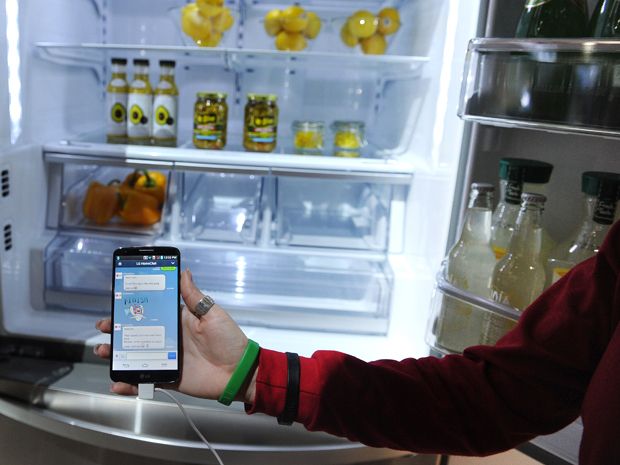
According to recent research, 70 percent of Americans plan to own network appliance in the next five years, at least one smart appliance like an internet-connected refrigerator or thermostat. That's a skyrocketing adoption rate considering the number of smart appliance owners in the United States today is just four percent.

Yet backdoors and other insecure channels have been found in many such network appliance devices, opening them to possible hacks, botnets, and other cyber mischief. Although the widely touted hack of smart refrigerators earlier this year has since been debunked, there’s still no shortage of vulnerabilities in the emerging, so-called Internet of Things.

Enter, then, one of the world’s top research centers devoted to IT security, boasting 700 students in this growing field, the Horst Gortz Institute for IT Security at Ruhr-University Bochum in Germany. A research group at HGI, led by Christof Paar—professor and networking aplliance chair for embedded security at the Institute—has been discovering and helping manufacturers patch security holes in Internet-of-Things devices like appliances, cars, and the wireless routers they connect with.

Paar, who is also adjunct professor of electrical and computer engineering at the University of Massachusetts at Amherst, says there are good engineering, technological, and even cultural reasons why security of the Internet of Things is a very hard problem.

For starters, it’s hard enough to get people to update their laptops and smartphones with the latest security patches. Imagine, then, a world where everything from your garage door opener, your coffeemaker, your eyeglasses, and even your running shoes have possible network appliance vulnerabilities. And the onus is entirely on you to download and install firmware updates—if there are any.

Furthermore, most Internet-connected “things” are net-savvier iterations of designs that have long pre-Internet legacies—legacies in which digital security had previously never been a major concern. But, Paar says, security is not just another new feature to be added onto an networking aplliance device. Internet security requires designers and engineers embrace a different culture altogether.

“There’s essentially no tolerance for error in security engineering.”
“There’s essentially no tolerance for error in security engineering,” Paar says. “If you write software, and the software is not quite optimum, you might be ten percent slower. You’re ten percent worse, but you still have pretty decent results. If you make one little mistake in security engineering, and the attacker gets in, the whole system collapses immediately. That’s kind of unique to security and crypto-security in general.”

Paar's research team, which published some of its latest findings in Internet-of-Things security this summer, spends a lot of time on physical and electrical engineering-based attacks on networking aplliance, also called side-channel attacks.

For instance, in 2013 Paar and six colleagues discovered rackmount in an Internet-connected digital lock made by Simons Voss. It involved a predictable, non-random number the lock’s algorithm used when challenging a user for the passcode. And the flaws in the security algorithm were discoverable, they found, via the wireless link between the lock and its remote control.

The way they handled the network box discovery was how they handle all security rackmount exploit discoveries at the Institute, Paar says. They first revealed the weakness to the manufacturers and offered to help patch the error before they publicized the exploit.

“They fixed the network box system, and the new generation of their rackmount is better,” he says. “They had homegrown crypto, which failed. And they had side-channel [security], which failed. So we had two or three vulnerabilities which we could exploit. And we could repair all of them."

Of the scores of papers and research reports the Embedded Security group publishes, Paar says one of the most often overlooked factors behind hacking is not technological vulnerabilities but economic ones.

“There’s a reason that a lot of this hacking happens in countries that are economically not that well off,” Paar says. “I think most people would way prefer having a good job in Silicon Valley or in a well-paying European company—rather than doing illegal stuff and trying to sell their services.”

But as long as there are hackers, whatever their circumstances and countries of origin, Paar says smart engineering and present-day technology can stop most of them in their network box tracks.

“Our premise is that it’s not that easy to do embedded security right, and that essentially has been confirmed,” he says. “There are very few systems we looked at that we couldn’t break. The shocking thing is the technology is there to get the security right. If you use state of the art technology, you can build systems that are very secure for practical rackmount applications.”

refer to:
http://spectrum.ieee.org/riskfactor/computing/networks/vulnerable-smart-devices-make-an-internet-of-insecure-things