"Industrial computer and cameras and Their Technical Features," the 6th annual camera survey published by FRAMOS, takes a look at the opinions of 15 international camera manufacturers and 43 end users of machine vision cameras, and what it might mean for network appliance and its future.
Those industrial computer manufacturers surveyed indicate that the applications for which users purchased their cameras varies. According to the survey, automation in production, quality assurance, and measuring technology each accounted for 22%, while automation in logistics automation (17%), and transport measurement (16%), came in just behind them. On the other hand, end users indicate that 25% purchased cameras for use in automation in production, while 22% planned to use the cameras for quality assurance. In addition, 17% intended on using the cameras for logistics automation, 11% in measurement technology, and 7% for embedded computer traffic measurement. In terms of pricing, networks users indicated via their answers that paying for a high-quality camera was worth it to them. Forty percent of users surveyed indicated that they purchased industrial computer with cameras between €1,000 and €3,000 while 30% purchased cameras between €650 and $1,000.
When it comes to industrial computer and networks image sensors, users identified Sony as the "leader of the pack,"while Aptina and Truesense were just behind. (Both of which were recently acquired by ON automation and industrial Semiconductor.) CMOSIS and embedded computer saw a considerable rise in popularity since last year, as both embedded computer companies released CMOS sensors with global shutter technology.
Nearly 71% of embedded computer manufacturers said that they believe CCD sensors will continue to have a share of 60% of the market in two years, while users believe CMOS and CCD will be on par by that time. Survey author Dr.-Ing. Ronald Muller, Head of Product Marketing FRAMOS suggested that this could be because CMOS sensors are less expensive than CCD, and that CCD industrial market leader Sony has been ramping up its efforts for CMOS sensors in industrial network appliance.
refer to:
http://embedded-computing.com/articles/embedded-tech-expectations-the-factory/
Fanless Embedded Computer and Rugged Embedded Computer / Embedded PC / Embedded SBC & Embedded System designed for harsh environment industrial automation applications with heat pipe technology. Scalable Intel Atom, Celeron, Core i, Core 2 Duo platforms fulfill your various requirements. Flexible expansion: Mini-PCIe, PCIe, PCI, Wi-Fi Products Categories
2014年8月26日 星期二
2014年8月19日 星期二
Acrosser will present its latest in-vehicle computers and embedded system at Guangzhou IT Week and Automechanika Frankfurt this September.
ACROSSER Technology, a world-leading industrial computer manufacturer, is pleased to announce its participation in Guangzhou IT Week and Automechanika Frankfurt. Both events take place in September, and we cordially welcome you to pay a visit.
Guangzhou IT Week (September 19–21, 2014 in Guangzhou, China)
Selected by the Taipei Computer Association (TCA), Acrosser is one of the few privileged Taiwanese manufacturers that will have the opportunity to exhibit its products at the Taiwan Pavilion Hall at Guangzhou IT week. These products include the in-vehicle PC AIV-HM76V0FL and the embedded system AES-HM76Z1FL. This year marks the 14th anniversary of Guangzhou IT week, and this year’s convention will feature the latest topics, such as smart city solutions, IoT, and cloud computing. Acrosser’s AES-HM76Z1FL is a mini PC (272mm × 183mm × 20mm) with unrivaled computing performance, and the in-vehicle computer is a perfect hardware solution for car applications.
Automechanika Frankfurt (September 16–20, 2014 in Frankfurt, Germany)
During this 5-day event, the Taiwan External Trade Development Council (TAITRA) will promote and display automotive products that have won the Taiwan Excellence Awards and the ITS/Telematics Top 100 Award. Acrosser’s fanless in-vehicle computers AR-V6100FL and AR-V6002FL will be greeting the audience at the TAITRA stand (located at Halle 4 Ebene 2 Stand J71). The Automechanika is an automotive trade fair held in 13 countries worldwide, and Acrosser’s in-vehicle computers are ready to win the hearts of visitors at this global event.
Acrosser Technology Co., Ltd.
Contact Us:
http://www.acrosser.com/inquiry.html
Product Information:
AES-HM76Z1FL
AIV-HM76V0FL
AR-V6100FL
AR-V6002FL
Contact Us:
http://www.acrosser.com/inquiry.html
Product Information:
AES-HM76Z1FL
AIV-HM76V0FL
AR-V6100FL
AR-V6002FL
2014年8月12日 星期二
Industrial computer survey provides potential glimpse into future of camera market
"Industrial Cameras and Their Technical Features," the 6th annual camera survey published by FRAMOS, takes a look at the opinions of 15 international camera manufacturers and 43 end users of machine vision cameras, and what it might mean for the future.
Those manufacturers surveyed indicate that the applications for which users purchased their cameras varies. According to the survey, automation in production, quality assurance, and measuring technology each accounted for 22%, while automation in logistics automation (17%), and transport measurement (16%), came in just behind them. On the other hand, end users indicate that 25% purchased cameras for use in automation in production, while 22% planned to use the cameras for quality assurance. In addition, 17% intended on using the cameras for logistics automation, 11% in measurement technology, and 7% for embedded computer traffic measurement. In terms of pricing, networks users indicated via their answers that paying for a high-quality camera was worth it to them. Forty percent of users surveyed indicated that they purchased cameras between €1,000 and €3,000 while 30% purchased cameras between €650 and $1,000.
When it comes to networks image sensors, users identified Sony as the "leader of the pack,"while Aptina and Truesense were just behind. (Both of which were recently acquired by ON automation and industrial Semiconductor.) CMOSIS and embedded computer saw a considerable rise in popularity since last year, as both companies released CMOS sensors with global shutter technology.
Nearly 71% of manufacturers said that they believe CCD sensors will continue to have a share of 60% of the market in two years, while users believe CMOS and CCD will be on par by that time. Survey author Dr.-Ing. Ronald Muller, Head of Product Marketing FRAMOS suggested that this could be because CMOS sensors are less expensive than CCD, and that CCD industrial market leader Sony has been ramping up its efforts for CMOS sensors in industrial applications.
refer to:
http://www.vision-systems.com/articles/2014/08/industrial-camera-survey-provides-potential-glimpse-into-future-of-camera-market.html
2014年8月4日 星期一
Sensing networks in industrial automation
Sensors are a huge part of industrial applications. IHS estimates that over 100 million discrete sensors were shipped into industrial automation sectors in 2013. These vary greatly in size, use, and capability. Not all sensors are small and simple: some offer extensive functionality and the ability to connect to wider industrial automation networks. These more capable embedded computer sensors are becoming critical for the collection of data from industrial environments. They are helping move towards the next stage of industrial automation, whether this is called advanced manufacturing, “Industry 4.0,” or something else.
As a brief overview, IHS views the term “Industry 4.0” as the combination of many factors and trends, including industrial networking, distributed embedded computer, cybersecurity, Big Data, and analytics, among other things, and combining these all to create a smart factory. Sensors offer great potential to gather extensive data from production lines and plants, which can increasingly be distributed via a network, analyzed, and then used to make better informed decisions. Benefits can include safety improvements, increased uptime, lower energy costs, and quicker or easier maintenance. There are potentials security concerns, however.
Of course, for this to be implemented it requires a sensor capable of transmitting data over a network. Networkable sensors still make up only a smaller portion of the market, with a large number using basic signals to transmit information to a Programmable Logic Controller (PLC). Those sensors that are able to transmit data directly over a network generally also have some level of intelligence too, which can take loads off the embedded computer or other controller.
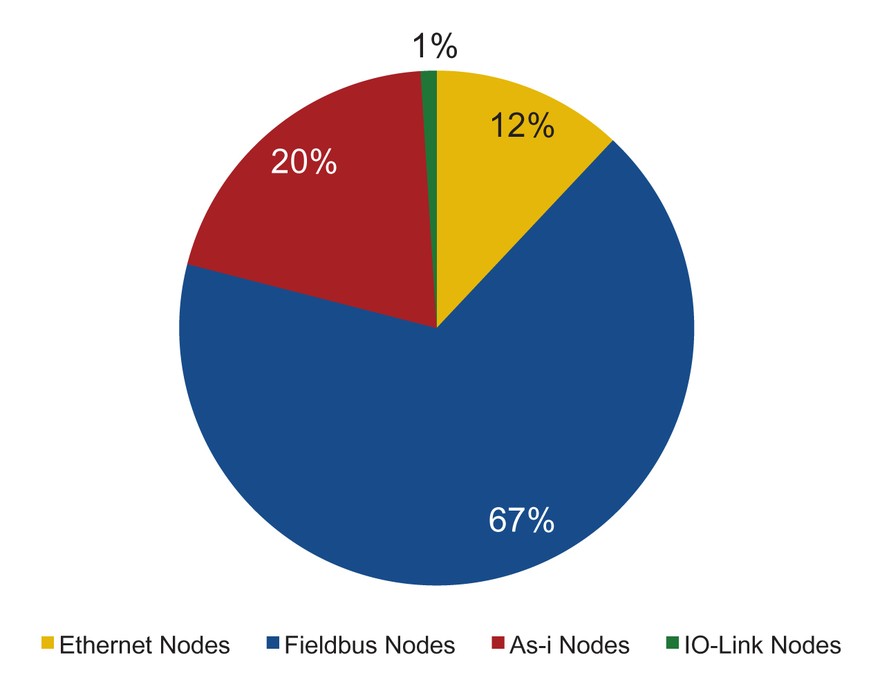
These sensors communicate with a wide array of networking technologies, be they Ethernet- or fieldbus-based. It shows the estimated split between the two technologies. AS-i and IO-Link, two technologies that are more orientated towards sensors, are also highlighted (IHS defines these as fieldbus technologies). It is clear that the vast majority of networkable sensors utilize fieldbus-based networks, often HART or PROFIBUS. An estimated one-fifth of devices use AS-i, and although it is not seen by some as a true networking technology, AS-i is widely used and has been adopted by most major sensor manufacturers.
IO-Link has the potential to be the main competition for AS-i in the future. However, there’s currently a lack of support from sensor vendors and the fact that AS-i has a safety variant may negatively impact on IO-Link adoption. In response, the IO-Link Safety group was recently founded, with a key aim of establishing a safety variant of the technology. Once this is available and proven, it should further bolster the excellent adoption rate that IO-Link is currently experiencing.
The remaining 12 percent share of networking technology adoption for sensors is split amongst a number of Ethernet variants. There are as many Ethernet variants as fieldbus, but they are considerably younger to market and as such are not yet as widely adopted. Fieldbus technologies are certainly not going to disappear overnight, but Ethernet adoption for sensor networking is growing more quickly. A variety of factors are driving this, but the most important is easy integration and interoperability with other industrial automation equipment that is already widely networked via Ethernet, be it in standard TCP/IP form or another embedded computer deterministic variant.
The popularity and growth of Ethernet adoption has filtered down from consumer/enterprise networking. It was first used at the industrial information level, then the controller level, and is now slowly being seen at the field level. The transition from fieldbus to Ethernet is going to take time, as factories and large plants are rarely refitted. This means that a large portion of embedded computer will continue to be fieldbus-based, or perhaps an Ethernet/fieldbus hybrid for some time. So while the door has been opened for advanced sensor networks, we are still a long way from moving towards ”Industry 4.0” and the benefits that a networked sensor array can bring.
refer to:
http://industrial.embedded-computing.com/articles/sensing-networks-industrial-automation/
2014年7月28日 星期一
Acrosser’s AMB-IH61T3 Mini-ITX Board is Now Available for Both the Gaming and Industrial Automation Industries.
When two separate devices need to communicate with each other on a single board computer, there should be a channel to bridge the communication: the COM port. Acrosser’s AMB-IH61T3 is a board that supports up to 10 COM ports for multiple applications.
AMB-IH61T3 and Gaming Solutions
AMB-IH61T3, the Mini-ITX form-factor single board computer, has many characteristics that those in the gaming industry long for. These characteristics include superior computing performance, numerous expansions, and a long life cycle. The board also features unrivaled connectivity with its remarkable 10 COM ports (1 x RS232, 1 x RS2323/485, and 8 x RS232 pin headers). For gaming machines or arcade vendors, multiple gaming peripherals, such as buttons, lamps, hoppers, or a coin acceptor, can all be integrated into the final gaming product, adding more depth and interactivity to the game. The combination of I/O, 10 COM ports, and dual display makes AMB-IH61T3 a suitable option for the gaming industry.
AMB-IH61T3 and Industrial Automation
In the automation industry, interconnection of multiple industrial measurement devices is a necessity. These devices include sensors, PLCs, servos, inverters, temperature controllers, barcode scanners, air quality monitors, etc. With proper design and verification, the 10-serial-port AMB-IH61T3 can easily integrate these devices and provide the perfect control center solution for industrial environments.
To learn more about the AMB-IH61T3 Mini-ITX board, please send us an inquiry , or contact your local Acrosser sales vendor for detailed information.
Contact Us:
http://www.acrosser.com/inquiry.html
2014年7月14日 星期一
Location, location, location: Experts offer advice for in-store kiosk placement
"It always amazes me to see the groups that just don't pay attention to kiosk location," said Frank Olea, CEO of Cerritos, California-based manufacturer Olea Kiosks Inc. "It's as if they assume that if you build it, they will come." But that is clearly not the case, according to kiosk indusrty experts. Customers are only interested in what really attractes their attention.
"The best location for any kiosk is where it will be best utilized for the optimum customer experience," said Greg Buzek, president of Franklin, Tennessee-based research firm IHL Group. "If the kiosk's purpose is providing industrial information, then the best place is either a high-traffic area or the store area where customers have the most questions. It makes little sense to have centralized answer kiosks when the bulk of the questions are for a specific area of the store. If you have several areas where customers might have frequent questions, position the answer kiosks consistently so customers know where to look to get the information they need to make buying decisions."
Think of a kiosk like a industrial automation business, Olea advises. "Why would you open a business on the worst possible street corner when you know it’s only destined to fail?" he said. "Just like a business, the kiosk needs to be well marked and highly visible to passersby. It needs to be easy to get to, and out of the flow of traffic."
If the kiosk is an entirely new category of service automation before, then the deployer must place it right in the most visible spot possible, Olea said. "This is because, otherwise, how would people know to even look for it?" he said. "If your kiosk isn't anything new, but you've taken something that always existed in one location and are now making it available in several locations, placement and adequate digital signage on and around the kiosks become important. Just placing your kiosks all over the store doesn't guarantee that people will find them. If customers do see the kiosks, but they don't have adequate signage, will they know what they are?"
Frank Meyer & Associates
"Depending on the function of the kiosk, placement should be a combination of visibility, accessibility and convenience for the consumer at the point of purchase and during the information-gathering process while they are shopping," said Ron Bowers, senior vice president of business development at Grafton, Wisconsin-based kiosk vendor Frank Mayer & Associates.
Bowers suggests the following locations:
Wayfinding kiosks should be placed at the entrance or front of the embedded computer to help consumers with their shopping process; Loyalty check-in kiosks should be near the cart corral to allow the consumer to initiate the shopping procedure, access coupons and download custom shopping lists; Endcap display kiosks let consumers download product information that targets their needs; Endless embedded computer in each of the store's sub-departments allow consumers to order products in sizes and colors that are not on the shelves; and Kiosks should be placed in the services department to reduce lines for product returns and to provide insight on customer relations.
TIO Networks
"Self-service kiosks are meant to be convenient for your customers, but users want to feel that their transactions are still private," said Jason Plante, senior director of supply chain management and logistics at Vancouver, Canada-based financial self-service kiosk company TIO Networks Corp. "Your kiosk placement should demonstrate both convenience and privacy while still being situated within the view of store staff so that they can help users who have questions."
Plante recommends:
For transactional kiosks, avoid high-traffic embedded computer areas such as next to the counter or entrances and exits. Self-service kiosk users who obstruct the normal flow of foot traffic within a location will only feel rushed to end their transaction, and they may not come back next time; Wherever your self-service kiosk is placed within your store, ensure the store staff understand the features and benefits of the kiosk. Your store staff become your embedded computer to all potential new kiosk users, and, if the staff don't convey a clear, positive experience to a potential new user, the customer may not use the terminal at all;
Placing your self-service terminal beside a familiar device such as an ATM may help users feel more comfortable using your kiosk for the first time; and Give your users enough room to conduct their business at your self-service kiosk. Similar to avoiding high-traffic areas, let your users feel comfortable at your kiosk.
Jibestream
"Every visitor has to pass by an entrance or exit at least twice in their visit to any store," said Nicholas Yee, product manager of Toronto, Canada-based wayfinding technology firm Jibestream. "That makes these locations great for messages, or for offering functionality that visitors should know about. From a wayfinding perspective, it's very useful to give users the ability to find what they’re looking for, right as they walk into the store."
For Yee, the best locations are:
Checkouts: Nobody enjoys waiting in line, so, while these visitors are probably already on their way to becoming a paying customer, why not present them with information that may attract them to pick up a second item during their trip? Then give them the ability to view directions on how they can get to that item in the store, right from the kiosk so that they can easily act on that impulse purchase. Waiting rooms: Recent studies have shown that in health care, informing users of what they can expect during their visit to the hospital via helpful signage and messaging can greatly reduce the number of frustrated visitors. By applying this concept to a commercial environment, stores can help their customer service staff by reducing the amount of aggravated customers they have to deal with. These customers may have become further aggravated as they wait in line. So why not give them access to a kiosk that can give them an engaging focus point, and help them be more time-efficient by allowing them to plan the rest of their trip through the store?
Near elevators and escalators: As people are travelling through a store, one of the key decision points during their journey is when they approach an elevator or escalator. If the retailer provides them with a wayfinding kiosk, customers can be sure of where they need to go next.
Promotional areas: In addition to physical signage located near areas displaying promotional campaigns, stores can leverage the high customer traffic that visits these areas by installing a kiosk. Stores can use the kiosk to promote events or sales, while increasing the number of people who will see the retailer's advertising. The kiosk can help manage a store’s traffic by diverting people from a high-traffic area to different places in the store via a wayfinding application.
refer to:
http://www.kioskmarketplace.com/articles/location-location-location-experts-offer-advice-for-in-store-kiosk-placement
2014年7月6日 星期日
Acrosser Releases the PCI-E x16 Slot AMB-IH61T3 Mini-ITX Board, for Your Industrial Automation System
ACROSSER Technology, a leading provider of industrial and embedded computers, debuted the AMB-IH61T3 today, an industrial Mini-ITX motherboard with the highest cost-performance ratio yet, powered by an Intel H61 chipset supporting 3rd/2nd Generation Intel® Core™ i7/i5/i3 processors.
Generous I/O Connectivity
The AMB-IH61T3 possesses high connectivity and multiple high-speed I/O ports. Built with 8 USB ports/headers and 10 serial ports/headers, this board provides sufficient and flexible connection possibilities, especially for KIOSK and industrial automation system integrators to link and manage multiple peripherals.
Expandable Graphic Power and Functionality
The Mini-ITX AMB-IH61T3 equipped with a PCI-E x16 slot, brings you not only more expanded functionality, but also enhanced graphic power. You can even choose to leverage an additional graphics card on top of the slot to improve visual effects for any kind of gaming application, or use the multiple displays for industrial automation purposes.
The industrial PC industry has been craving smaller, more affordable portable computing devices. We responded to this demand by introducing our cost-effective Mini-ITX platform AMB-IH61T3, making mini-computing more usable and redefining the embedded SBC market.
Product Information:
Here’s our AMB-IH61T3 Product Film
Contact us:
訂閱:
文章 (Atom)